Books
Currently Reading (2)

2026 (5)




2025 (17)









2024 (14)







2023 (21)













2022 (14)





2021 (21)







2020 (24)







2019 (26)








My father has never been able to imagine the world without himself in it.
It is youth’s gift not to feel its debt.
But perhaps no parent can truly see their child. When we look we see only the mirror of our own faults.
Monastic: completely left alone
bimodal: stretches of distraction, stretches of deep work, at least a day.
rhythmic: chain method, building habits into the day.
- Focus on the wildly important
- Act on the lead measures
- Keep a compelling scoreboard
- Create a cadence of accountability
You cannot expect an app dreamed up in a dorm room, or among the Ping-Pong tables of a Silicon Valley incubator, to successfully replace the types or rich interactions to which we’ve painstakingly adapted over millennia.
Nobel-Prize winning economist and philosopher Amartya Sen has also examined the nature and importance of freedom and autonomy and the conditions that promote it. In his book /Development as Freedom/ he distinguished the importance of choice, in and of itself, from the functional role it plays in our lives. He suggests that instead of being fetishistic about freedom of choice, we should ask ourselves whether or nourishes us or deprives us, whether it makes us mobile or hems us in, whether it enhances self-respect or diminishes it, and whether it enables us to participate in our communities or prevents us from doing so. So the TV experience is now the very essence of choice without boundaries. In a decade or so, when these boxes are in everybody’s home, it’s a good bet that when folks gather around the water cooler to discuss last night’s big TV events, no two of them will have watched the same shows. When Nobel-Prize winning economist and psychologist Herbert Simon initially introduced the idea of “satisficing” in the 1950, he suggested that when all the costs (in time, money, and anguish) involved in getting information about all the options are factored in, satisficing is, in fact, the maximizing strategy. In other words, the best people can do, all things considered, is to satisfice. Rules, presumptions, standards “Security is more important than wealth”
Edison, Albert Einstein, and Salvador Dali all recognized that sleep spurred their creativity, and developed a similar practice to harness it. They would put something heavy in their hand (Edison used steel balls, Dali and Einstein, a key) and sit in a chair. When they grew drowsy and relaxed, they would drop the object and wake up. That’s when they felt like they came up with their biggest creative ideas (and perhaps broken toes).
Ten minutes of quality, devoted practice yields more than an hour of distracted efforts
People convince themselves that they have been robbed when they have not, in fact, been robbed. Such thinking comes from a wretched allegiance to the notion of scarcity — from the belief that the world is a place of dearth, and that there will never be enough of anything to go around. The motto of this mentality is: Somebody else got mine. Had I decided to take that attitude, I would surely have lost my dear new friend. I also would have collapsed into a state of resentment, jealousy, and blame.
Going into massive debt in order to become a creator, then, can make a stress and a burden out of something that should only ever have been a joy and a release. And after having invested so much in their education, artists who don’t immediately find professional success (which is most artists) can feel like failures. Their sense of having failed can interfere with their creative self-confidence — and maybe even stop them from creating at all. Then they’re in the terrible position of having to deal not only with a sense of shame and failure, but also with steep monthly bill that will forever remind them of their shame and failure.
Quit your complaining. It’s not the world’s fault that you wanted to be an artist. It’s not the world’s job to enjoy the films you make, and it’s certainly not the world’s obligation to pay for your dreams. Nobody wants to hear it. Steal a camera if you must, but stop whining and get back to work.
I finished Code: The Hidden Language of Computer Hardware and Software by Charles Petzold this morning. I’ve been reading a chapter or two each morning for a while now. It does a great job of breaking down how a computer works, by explaining conceptually why humans created things like morse code, braille, binary, boolean logic, electromagnetic gates, the Jacquard loom (!), until we ended up combining a lot of those concepts and creating computers. Some of the middle chapters hurt my brain a bit: the jump from sending a signal down a diverted wire to light up a light bulb, to storing state in a loop, to computer RAM… it’s well explained, but if there was some planet-wide disaster tomorrow don’t expect me to start the first fabrication plant.
As someone who writes software but doesn’t have a CS or EE degree, and as someone who grew up mostly using computers with GUIs, this book filled in some of the gaps in my brain, like why hex values use the colors they use, how memory addresses work, how CPU frequency is determined and what it means, why the computers I used growing up gave you a choice between number of colors and resolution, why JavaScript is bad at math, the list goes on. There’s a one line note about Java, a language I generally despise, but after an entire chapter on languages communicating with machine code and operating systems communicating with hardware, I can appreciate Java and the JVM considerably more.
The book was published in 2000, and the later chapters move from the general to the specifics of the early days of Intel/Motorola and IBM/Windows/Macintosh, and it feels a little like opening a time capsule because of that. Petzold references Radio Shack as a place to buy computer parts, which made me intensely miss the feeling of browsing the bins at a Radio Shack. Steve Jobs and the Macintosh are mentioned in the context of managing hardware requirements to provide an entirely graphical operating system, an oft repeated story about the philosophical differences between Windows and Macs, but it’s interesting to think that in 2000 I had a Windows PC, and today my watch, phone, TV, the speaker closest to me, the tablet I’m writing this on, and the computer upstairs all run on variations of Apple operating systems built for Apple hardware.
Speaking of the, speaker, Petzold mentions the idea of virtual assistants late in the book, although not by that name:
Everybody knows from science fiction movies and television shows that computers of the future converse with their users in spoken English. Once a computer is equipped with hardware to digitally record and play back sound, everything else involved in this goal is a software problem.
The book ends on the theme that once you have the capacity to digitize things (numbers, text, music, movies, photos), everything becomes a software problem. There’s probably another book to be written here that once everything becomes a software problem, all software becomes a social problem. There’s exactly one paragraph on the internet, which serves to nicely tie the end of the book to the beginning (I won’t ruin it, read it yourself).
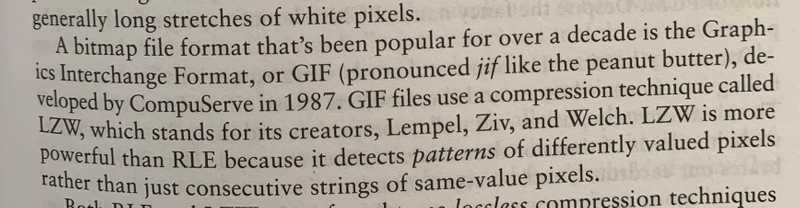
Also of note — the pronunciation of GIF:
….but there’s a difference between being intelligent and knowing what to do with your life, also a difference between knowing that a college degree might change your life and a willingness to actually commit to the terrifying weight of student loans, especially since she’d worked alongside enough bartenders with college degrees to know that a college degree might not change anything at all, etc. etc….
There’s something in it, he decides later, standing in line for dinner. It’s possible to know you’re a criminal, a liar, a man of weak moral character, and yet not know it, in the sense of feeling that your punishment is somehow undeserved, that despite the cold facts you’re deserving of warmth and some kind of special treatment. You can know that you’re guilty of an enormous crime, that you stole an immense amount of money from multiple people and that this caused destitution for some of them and suicide for other, you can know all of this and yet still somehow feel you’ve been wronged when your judgement arrives.
Politics neccessarily exist between even two individuals with free will; any attempt to reduce politics to design (Thiel’s “machinery of freedom”) is also an attempt to reduce people to machines or mechanical beings. So when Thiel writes of “new technologies that may create a new space for freedom,” I hear only an echo of Frazier: “Their behavior is determined, yet they’re free.”
As much as I might want to live in the woods where my phone doesn’t work, or shun newspapers with Michael Weiss at his cabin in the Catskills, or devote my life to contemplating potatoes in Epicurus’s garden, total renunciation would be a mistake. The story of the communes teaches me that there is no escaping the political fabric of the world (unless you’re Peter Thiel, in which case there’s always outer space). The world needs my participation more than ever. AGain, it is not a question of whether but how.
Back in 2013, students in my first art classes at Stanford were surprised that I didn’t know about “Stanford duck syndrome.” This phrase, which imagines students as placid-seeming ducks paddling strenously beneath the water, is essentially a joke about isolate struggle in an atmosphere obsessed with performance.
It may be that refusal is only available as a tactic to people who already posses a great deal of social capital, people whose social standing will endure without Facebook and people whose livelihoods don’t require them to be constantly plugged in and reachable… These are people who have what [Kathleen] Noonan (2001) calls “the power to switch off.”
Spacial and temporal context both have to do with the neighboring entities aorund something that help define it. Context also helps establish the order of events. Obviously, the bits of information we’re assailed with on Twitter and Facebook feeds are missing both of these kinds of context. Scrolling through the feed, I can’t help but wonder: What am I supposed to think of all this? How am I supposed to think of all this?
But because apologizing and changing our minds online is so often framed as a weakness, we either hold our tongues or risk ridicule. Friends, family, and acquaintances can see a person who lives and grows in space and time, but the crowd can only see a figure who is expected to be as monolithic and timeless as a brand. Having worked for an old and widely recognized clothing company, I know firsthand that the pillars of any brand are internal coherence and consistency over time. (That’s literally what we called them at work: “brand pillars.”) For a brand as a for a public figure —which, as we now know, any Twitter user can accidentally become overnight—change, ambiguity, and contradiction are anathema. “You have one identity,” Mark Zuckerberg famously said. “The days of you having a different image for your work friends or co-workers and for the other people you know are probably coming to an end pretty quickly.” He added that “having two identities for yourself is an example of a lack of integrity.”
From Community Memory:
Our intention is to introduce COMMUNITY MEMORY into neighborhoods and communities in this area, and make it available for them to live with it, play with it, and shape its growth and development. The idea is to work with a process whereby technological tools, like computers, are used by the people themselves to shape their own lives and communities in sane and liberating ways. In this case the computer enables the creation of a communal memory bank, accessible to anyone in the community. With this, we can work on providing the information, services, skills, education, and economic strength our community needs. We have a powerful tool—a genie—at our disposal; the question is whether we can integrate it into our lives, support it, and use it to improve our own lives and survival capabilities. We invite your participation and suggestions.
I think often about how much time and energy we use thinking up things to say that would go over well with a context-collapsed crowd—not to mention checking back on how that crowd is responding. This is its own form of “research,” and when I do it, it feels not only pathetic but like a waste of energy. What if we spent that energy instead on saying the right things to the right people (or person) at the right time? What if we spent less time shouting into the void and being washed over with shouting in return—anymore time talking in rooms to those for whom our words are intended? Whether it’s a real room or a group chat on Signal, I want to see a restoration of context, a kind of context collection in the face of context collapse. If we have only so much attention to give, and only so much time on this earth, we might want to think about reinfusing our attention and our communication with the intention that both deserve.
Behind them rose the skyline of San Francisco, with its new Salesforce tower and its high-rise condos. If I squinted, I could just make out the building where I used to work, where they might have been discussing “brand pillars” at this very moment. Back there, things moved so quickly that we had separate catalogs for Spring 1, Spring 2, and Spring 3. but the pelicans made all of that seem like a joke with no punchline. Based on a fossil dating from the Oligocene Epoch, the general design of the pelican appears not to have changed for 30 million years. In the winter, as they have for countless ages, the pelicans will be heading south to the Channel Islands and to Mexico to build the nests who designs, too, have remained largely unchanged.
I started collecting local stories and would test them on the boys as we drove around in the van. If they liked a story or found it surprising, I would use it in the show. I was a full-fledged director now, and I’d promised Ueno I would do my best to satisfy the “unique sensibilities” of the Japanese television audience; since I wasn’t Japanese, I used the boys as my barometer. Traveling across America, they were astonished at how deeply violence is embedded in our culture, how it has become the culture, what’s left of local color. We are a grisly nation.
As one oncologist put it, “The difference between winning at Jeopardy! and curing all cancer is that we know the answer to Jeopardy! questions.” With cancer, we’re still working on posing the right questions in the first place.
Mostly, though, students get what economist Bryan Caplan called narrow vocational training for jobs few of them will ever have. Three-quarters of American college graduates go on to a career unrelated to their major — a trend that includes math and science majors — after having become competent only with the tools of a single discipline.
Vivaldi wrote oboe parts specifically for Pelegrina, but in her sixties her teeth fell out, abruptly ending her oboe career. So she switched back to violin, and continued performing into her seventies.
Compared to the Tiger Mother’s tome, a parenting manual oriented toward creative achievement would have to open with a much shorter list of rules. In offering advice to parents, psychologist Adam Grant noted that creativity may be difficult to nature, but it is easy to thwart. He pointed to a study that found an average of six household rules for typical children, compared to one in households with extremely creative children. The parents with creative children made their opinions known after their kids did something they didn’t like, they just did not proscribe it beforehand. Their households were low on prior restraint.
It can even help to be wildly wrong. Metcalfe and colleagues have repeatedly demonstrated a “hypercorrection effect.” The more confident a learn is of their wrong answer, the better the information sticks when they subsequently learn the right answer. Tolerating big mistakes can create the best learning opportunities.
Platforms like Medium and LinkedIn are absolutely rife with posts about shiny new, unsupported learning hacks that lead to mind-glowingly rapid progress—from special dietary supplements and “brain-training” apps to audio cues meant to alter brain waves. In 2007, the U.S. Department of Education published a report by six scientists and an accomplished teacher who were asked to identify learning strategies that truly have scientific backing. Spacing, testing, and using making-connections questions were on the extremely short list. All three impair performance in the short term.
“Above all, the most basic message is that teachers and students must avoid interpreting current performance as learning. Good performance on a test during the learning process can indicate mastery, but learners and teachers need to be aware that such performance will often index, instead, fast but fleeting progress.
Winston Churchill’s “never give in, never, never, never, never” is an oft-quoted trope. The end of the sentence is always left out: “except to convictions of honor and good sense.”
Seth Godin, author of some of the most popular career writing in the world, wrote a book disparaging the idea that “quitters never win.” Godin argued that “winners”—he generally meant individuals who reach the apex of their domain—quit fast and often when they detect that a plan is not the best fit, and do not feel bad about it. “We fail,” he wrote, when we stick with “tasks we don’t have the guts to quit.”
Psychologist Dan Gilbert called it the “end of history illusion.” From teenagers to senior citizens, we recognize that our desires and motivations sure changed a lot in the past (see: your old hairstyle), but believe they will not change much in the future. In Gilbert’s terms, we are works in progress claiming to be finished.
Rose framed it more colloquially: “If you are conscientious and neurotic while driving today, it’s a pretty safe bet you will be conscientious and neurotic while driving tomorrow. At the same time … you may not be conscientious and neurotic when you are playing Beatles cover songs with your band in the context of the local pub.”
Paul Graham, computer scientist and cofounder of Y Combinator—the start-up funder of Airbnb, Dropbox, Stripe, and Twitch—encapsulated Ibarra’s tenets in a high school graduation speech he wrote, but never delivered: “It might seem that nothing would be easier than deciding what you like, but it turns out to be hard, partly because it’s hard to get an accurate picture of most jobs…..Most of the work I’ve done in the last ten years didn’t exist when I was in high school…..In such a world it’s not a good idea to have fixed plans.”
Even though he was revered by then, Yokoi had to push and shove internally for his “lateral thinking with withered technology” concept to be approved for the Game Boy. “It was difficult to get Nintendo to understand,” he said later. Yokoi was convinced, though, that if users were drawn into the games, technological power would be an afterthought. “If you draw two circles on a blackboard, and say, ‘That’s a snowman,’ everyone who sees it will sense the white color of the snow,” he argued.
“Do not be an engineer, he said, be a producer. “The producer knows that there’s such a thing as a semiconductor, but doesn’t need to know its inner workings…. That can be left to the experts.”
Eminent physicist and mathematician Freeman Dyson styled it this way: we need both focused frogs and visionary birds. “Birds fly high in the air and survey broad vistas of mathematics out to the far horizon,” Dyson wrote in 2009. “They delight in concepts that unify our thinking and bring together diverse problems from different parts of the landscape. Frogs live in the mud below and see only the flowers that grow nearby. They delight in the details of particular objects, and they solve problems one at a time.” As a mathematician, Dyson labeled himself a frog, but contended, “It is stupid to claim that birds are better than frogs because they see farther, or that frogs are better than birds because they see deeper.” The world, he wrote, is both broad and deep. “We need birds and frogs working together to explore it.”
Taylor and Greve expected a typical industrial production learning curve: creators learn by repetition, so creators making more comics in a given span of time would make better ones on average. They were wrong. Also, as had been shown in industrial production, they guessed that the more resources a publisher had, the better its creators’ average product would be. Wrong. And they made the very intuitive prediction that as creators’ years of experience in the industry increased, they would make better comics on average. Wrong again.
A high-repetition workload negatively impacted performance. Years of experience had no impact at all. If not experience, repetition, or resources, what helped creators make better comics on average and innovate?
The answer (in addition to not being overworked) was how many of twenty-two different genres a creator had worked in, from comedy and crime, to fantasy, adult, nonfiction, and sci-fi. Where length of experience did not differentiate creators, breadth of experience did. Broad genre experience made creators better on average and more likely to innovate.
Griffin’s research team noticed that serial innovators repeatedly claimed that they themselves would be screened out under their company’s current hiring practices. “A mechanistic approach to hiring, while yielding highly reproducible results, in fact reduces the numbers of high-potential [for innovation] candidates,” they wrote.
The integrators outperformed their colleagues on pretty much everything, but they especially trounced them on long-term predictions. Eventually, Tetlock conferred nicknames (borrowed from philosopher Isaiah Berlin) that became famous throughout the psychology and intelligence-gathering communities: the narrow-view hedgehogs, who “know one big thing,” and the integrator foxes, who “know many little things.”
Incredibly, the hedgehogs performed especially poorly on long-term predictions within their domain of expertise. They actually got worse as they accumulated credentials and experience in their field. The more information they had to work with, the more they could fit any story to their worldview. This did give hedgehogs one conspicuous advantage. Viewing every world event through their preferred keyhole made it easy to fashion compelling stories about anything that occurred, and to tell the stories with adamant authority. In other words, they make great TV.
A hallmark of interactions on the best teams is what psychologist Jonathan Baron termed “active open-mindedness.” The best forecasters view their own ideas as hypotheses in need of testing. Their aim is not to convince their teammates of their own expertise, but to encourage their teammates to help them falsify their own notions. In the sweep of humanity, that is not normal. Asked a difficult question—for example, “Would providing more money for public schools significantly improve the quality of teaching and learning?”—people naturally come up with a deluge of “myside” ideas. Armed with a web browser, they don’t start searching for why they are probably wrong. It is not that we are unable to come up with contrary ideas, it is just that our strong instinct is not to.
In a study during the run-up to the Brexit vote, a small majority of both Remainers and Brexiters were able to correctly interpret made-up statistics about the efficacy of a rash-curing skin cream, but when voters were given the same exact data presented as if it indicated that immigration either increased or decreased crime, hordes of Brits suddenly became innumerate and misinterpreted statistics that disagreed with their political beliefs. Kahan found the same phenomenon in the United States using skin cream and gun control. Kahan also documented a personality feature that fought back against that propensity: science curiosity. Not science knowledge, science curiosity.
Margaret Mead wrote, “A society that cuts off older people from meaningful contact with children, a society that segregates any group of men and women in such a way that they are prevented from having or caring for children, is greatly endangered.” Bullshit, I’d thought when I read this in college. If I ever have kids of my own, I’d sooner let a stranger on the street help me care for them than the lunatics who raised me.
When child-rearing is something most people do for one reason or another (economic necessity, religious obligation, creating future warriors for battling rival tribes, and so on), when birthrates are high, parenthood common, children abundant and well integrated into various aspects of communal life, a baseline level of cooperation and benefit-of-the-doubt-giving pervades. But when being a parent is elevated to the most important thing you will ever do, a thing you in particular have chosen, a special duty and responsibility that only some accept, the stakes rise. If parenthood is no longer just a relationship or a part of “ordinary life” but instead a new kind of secular religion, then true tolerance of each other’s parenting differences becomes a lot more complicated and a lot less common. As Paula S. Fass writes in The End of American Childhood, “Once having children is defined as an individual choice, American parents often imagine that when they do not succeed or are less than completely successful … it is somehow their fault. Having made the choice, they are somehow obligated to do it right.” But obligated to whom?
The hoary, cobwebbed old wisdom is that parenthood is supposed to make you a better person. In some ways, this is true. Parenthood offers the opportunity to engage in a deeply intimate relationship with a human who is dependent on you for all of his physical, emotional, and psychological needs. It demands patience, sacrifice, compassion, and humility. It stretches us in ways not many experiences can. But at the same time, I began to realize, there was something about it that made people worse or, at least, worse to each other—worse neighbors, worse citizens, worse friends. That something, I’d come to see, was not parenthood itself but the anxiety that so often surrounds it.
“This shift that’s taken place, this idea that it is not safe for children to be out of our sight at any moment, this idea that a good parent is a parent who watches and manages and meddles and observes ceaselessly. This is not insignificant. This has profound consequences in the lives of parents and children. And most importantly, Kim, this is a shift that is not rooted in fact. It’s not rooted in any true change or any real danger. This shift is imaginary. It’s make-believe. It’s rooted in irrational fear.”
And yet, it feels as though nothing I do as an individual is going to have much of an impact on increasing class stratification or the melting ice caps or the rise of right-wing populism. Sure, I can donate and agitate, drive less, organize, and vote my conscience, but is this really going to make a difference? So much of what happens in the world falls beyond our narrow sphere of influence, and so our grip tightens on what we think we can control, on everything within reach. If one sees fear in this context, not as a passive state but as a thing we produce, a thing we do to soothe our feelings of helplessness in a largely indifferent world, the child-rearing style that Frank Furedi calls “paranoid parenting” begins to make sense
She goes on to say that if we feared rationally, we’d worry about obesity and diabetes, we’d worry about how to keep our kids far away from sugary juices, we’d worry about young drivers killed in moving-vehicle crashes, we’d worry about things like teen depression or cigarette addiction. Instead, we tend to focus on occurrences that are far less likely, and yet somehow more frightening. “The fact is,” she says, “having your kid get fat and develop heart disease and die before her time is sad, but it doesn’t scare people. There’s no Law and Order: Diabetes Unit. Instead, the media fixate on these nightmare scenarios with fascination because they scare us in a delicious way, like horror movies. The Centers for Disease Control warn that if current trends continue, one in three US adults could have diabetes by 2050, whereas a child’s chances of being abducted and murdered are way less than one in a million. On average, you’d have to leave your kid outside, unsupervised, for 750,000 years for this to happen. But abduction is titillating, it’s exciting, it has something to do with sex, something to do with violence. And the part of our brain that deals with assessing threats did not evolve to see threats like diabetes and heart disease, things that kill you slowly over a long period of time.”
These were the thoughts that met me when I opened my eyes in the morning. They were with me when I was with him, and they followed me when I tried to work. He was not a hardy baby, but would he be sickly forever? He wasn’t putting words together as much as expected or engaging in extended play. Did he have autism, a hearing problem, some other mysterious deficiency? Could I help him by doing something differently, giving him more time, more attention, by reading a book on new parenting styles or making my own baby food or learning the art of infant massage? Was I doing everything I could for him? Would he get into a good preschool, a good grade school, a decent college? Would he find a job, a calling, friends and lovers and eventually a mate? Would he have a rewarding career that paid the bills and filled his soul? Would he continue to love and value me? When he thought of me twenty years from now, or thirty, or fifty, would he think I’d done well? Would I be a point of pride and affection or of loathing and shame? And would any of this even matter? Would there still be colleges when it was time for him to go to school? An economy when it was time for him to get a job? Drinkable water or breathable air? One question led to another, which led to another, an endless train of worry chugging along.
“How did you get through it?” I asked her. I was hoping she was going to recommend a book, a pill, some quick fix to make this feeling of inadequacy go away. Instead, she looked at me kindly, quite earnestly, and said, “You know, I think after years and years, I learned to stop giving a fuck. If people I knew, friends or relatives or strangers or whoever, had an opinion about what kind of mother I was or wasn’t, if they thought I was making mistakes, or doing things the wrong way, being too this or too that, being selfish by not giving all of myself to my kids, I eventually decided, fuck ’em. I’m doing the best I can in a culture that offers parents little material or emotional support. If people have a problem with the way I’m doing it, fuck every last one of them. And it’s funny—that anger—that was what got me to a place where I could finally stop caring and enjoy the little monsters. That’s when I started feeling better.”
“People assume that having money makes you happy or having children makes you happy or being married makes you happy … but actually the thing that makes people happy is how much control they have over how they spend their time.”
What is your stretch Goal? To run a marathon
What is a specific subgoal? Run seven miles without stopping
How will you measure success? Twice around the park, no walking
Is this achievable? Yes, if I run three times a week
Is this realistic? Yes, if I wake up early on Mondays, Wednesdays, and Fridays
What is your timeline? Run three miles this week, four miles next week, five miles…
“Internal locus of control has been linked with academic success, higher self-motivation and social maturity, lower incidences of stress and depression, and longer life span,” a team of psychologists wrote in the journal Problems and Perspectives in Management in 2012. People with an internal locus of control tend to earn more money, have more friends, stay married longer, and report greater professional success and satisfaction.
“A lot of poker comes down to luck,” Annie told me. “Just like life. You never know where you’ll end up. When I checked myself into the psych hospital my sophomore year, there’s no way I would have guessed I would end up as a professional poker player. But you have to be comfortable not knowing exactly where life is going. That’s how I’ve learned to keep the anxiety away. All we can do is learn how to make the best decisions that are in front of us, and trust that, over time, the odds will be in our favor.
About Project Oxygen, from Google: a good manager:
- Is a good coach
- Empowers and does not micromanage
- Expresses interest and concern in subordinates’ success and well-being
- Is results oriented
- Listens and shares information
- Helps with career development
- Has a clear vision and strategy
- Has key technical skills
That’s one of the reasons why your cable company asks all those questions when you sign up for service. If they ask if you prefer a paperless bill to an itemized statement, or the ultra package versus the platinum lineup, or HBO to Showtime, you’re more likely to be motivated to pay the bill each month. As long as we feel a sense of control, we’re more willing to play along.
Every choice we make in life is an experiment. Every day offers fresh opportunities to find better decision-making frames. We live in a time when data is more plentiful, cheaper to analyze, and easier to translate into action than every before. Smartphones, websites, digital databases, and apps put information at our fingertips. Bit it only becomes useful if we know how to make sense of it.
The EI had worked because instead of passively absorbing data, teachers made it “disfluent”- harder to process at first, but stickler once it was really understood.
“Something special happened inside those data rooms,” said Macon, the principal. South Avondale improved not because teachers had more information but because they learned how to understand it. “With Google and the Internet and all the information we have now, you can find answers to almost anything in seconds,” said Macon. “But South Avondale shows there’s a difference between finding an answer and understanding what it means.”
“Creativity is just connecting things,” Apple cofounder Steve Jobs said in 1996. “When you ask creative people how they did something, they feel a little guilty because they didn’t really do it, they just saw something. It seemed obvious to them. after a while. That’s because they were able to connect experiences they’ve had and synthesize new things. And the reason they were able to do that was that they’ve had more experiences or they have thought more about their experiences than other people.” People become creative brokers, in other words, when they learn to pay attention to how things make them react and feel.
There were, however, two behaviors that all the good teams shared.
First, all the members of the good teams spoke in roughly the same proportion, a phenomenon the researchers referred to as “equality in distribution of conversational turn-taking.” In some teams, for instance, everyone spoke during each task. In other groups, conversation ebbed from assignment to assignment — but by the end of the day, everyone had spoken roughly the same amount. “As long as everyone got a change to talk the team did well,” said Woolley. “But if only one person or a small group spoke all the time, the collective intelligence declined. The conversations didn’t need to be equal every minute, but in aggregate, they had to balance out.” Second, the good teams tested as having “high average social sensitivity” — a fancy way of saying that the groups were skilled at inviting how members felt based on their tone of voice, how people held themselves, and the expressions on their faces.
As her research continued Edmondson found a handful of good norms that seemed to be consistently associated with higher productivity. On the best teams, for instance, leaders encouraged people to speak up; teammates felt like they could expose their vulnerabilities to one another; people said they could suggest ideas without fear of retribution; the culture discouraged people from making harsh judgements. As Edmondson’s list of good norms grew, she began to notice that everything shared a common attribute: They were all behaviors that created a sense of togetherness while also encouraging people to take a chance.
That’s one of the reasons why your cable company asks all those questions when you sign up for service. If they ask if you prefer a paperless bill to an itemized statement, or the ultra package versus the platinum lineup, or HBO to Showtime, you’re more likely to be motivated to pay the bill each month. As long as we feel a sense of control, we’re more willing to play along. (p. 20)
The 5,4,3,2,1 Exercise:
A great way to get motivated is by realizing just how limited your time really is. The 5,4,3,2,1 exercise is designed to help you contextualize your goals in terms of time. It will quantify your objectives by breaking them down over the short, mid, and long term. If you’re struggling to tackle your goals, give this a try.
The TL;Don’t want to read again: write down all of your goals, no matter the scale or feasibility. Make to spreads, one for personal, one for professional. Make a line across both pages marking off:
- 5 years
- 4 months
- 3 weeks
- 2 days
- 1 hours Map your goals to those blocks. Pick the highest priority one in each block. Those are your goals.
Giving your page its Topic provides that opportunity to pause. What will you capture in this space? What’s its purpose? What value will it add to your life? These may seem like superfluous considerations, but I can’t tell you how many times I’ve sat down to make yet another list, only to realize that it simply wouldn’t add anything meaningful to my life. Does tracking the TV shows I’ve watched this year ad any real value? No. I can reinvest that time I saved into something that does. Other times, that pause has helped me refine my aims, keeping the content of my Bullet Journal focused and relevant. Topic by Topic, pause by pause, we’re honing our ability to focus on what matters.
Being busy can be likened to tumbling down an existential staircase: stimulus, reaction, stimulus, reaction. This frenetic cycle of reactivity holds our attention hostage, limiting our ability to recognize opportunities for love, growth, and purpose. These are the things that add value to our lives, yet they’re easily obscured by the rush of our busy lives.
In the bad old days, when we spent most of our time, you know, trying not to die, pleasure was limited and practical. Nowadays it’s a commodity, marketed as a substitute for happiness, and it’s on demand.
Your notebook does not have to be beautiful to be valuable. Design should always serve a purpose. If it also happens to be beautiful, great! As long as it does not get in the way.
As I struggled to master these tasks, I felt rushed and anxious when I couldn’t figure something out right away, until I hit upon a way to help myself slow down: I “pt myself in jail.” “I’m in jail,” I’d tell myself. “I’m locked up with nowhere to go and nothing to do except the task in front of me. It doesn’t matter how long it takes, I have ll the time I want.” Of course, this wasn’t true, but telling myself that I had all the time I needed helped me to focus.
I thoroughly enjoyed this book, the quotes I highlighted were somewhat random.
Jen had to go sit on the bus for the rest of the field trip, too traumatized to taunt the actors like the rest of the kids, asking the 1600s costumed characters if they had VCRs at home.
I know why I highlighted this: it’s about Plymouth Plantation, my dad did this to the actors there, insisting that one of their fake felled trees could have never been cut down with a handsaw.
Being the funny one was shrewd, too, because all four of us kids were comedy nerds. My older siblings understood shows like Monty Python and Saturday Night Live and I watched too, smiling, laughing when they laughed, and usually falling asleep. By going as hard as I could into something everyone liked, I thought, I would therefore by loved. Solid logic, confused little boy!
Landing Atticus meant that I was good at something and that I had proven my worth. Only decades later would it dawn on me that normal people who never deal with depression have a sense of self-worth automatically. Just by being a person on the earth, they fell themselves worthy of respect and love and all that other cool stuff.
If I write plays, on the other hand, I can type out my own dreams for others to inhabit, allowing me to stay home and isolate myself from the world. It sounded a lot easier, and I could wear those sweatpants. Of course, now, the idea of isolation and sweatpants is a dead giveaway for depression, but at the time it seemed very sensible. I announced to anyone who would listen that I was now a writer, and since no one ever checks and there’s no official state certification for that, people believed me.
“This is common for people with all the different things that we have,” she said, “which is that if I can do it, then it must be dumb. If I can do it, it’s not that hard. So everything I ever did that was like a big deal, I’d be like, oh well, I guess it’s not a big deal. I though that would be a big deal, but it’s not because I could do it. So that means any idiot could do it, so on to the next thing that I think is hard. And then if I achieve it, then I guess, Yeah, that turned out to be not really important either….
I’d grown up in a house with substance use issues, traumas both inherited and generated, and a series of cultural beliefs that silenced any meaningful conversation or action to deal with them. I thought a strong undercurrent of pain and toxicity was part of being in a family. If I think it’s normal but it has always felt fundamentally bad, it’s not really normal at all. It is a problem. The problem has a name. The problem’s name is depression.
Mentally healthy people can intuitively regulate the time they spend in self-contemplation and balance it with time they spend just living. Normies such as these might do some yoga or meditation, possibly make lists of goals, read the occasional self-help book, but then they’ll hang out with friends drinking Chablis at Olive Garden or seeing a Bradley Cooper movie. Look, man, I don’t really know how the norms spend their time. They don’t have to worry about getting trapped in their own worst thoughts or running from those thoughts for years at a time; they parry away those thoughts with languid élan. It’s an instinct for the norms, like being able to show up to parties.
But when we really delve into the reasons reasons for why we can’t let something go, there are only two: an attachment to the past or a fear for the future.
Clutter is caused by a failure to return things to where they belong. Therefore, storage should reduce the effort needed to put things away, not the effort needed to get them out.
The fact that you posses a surplus of things that you can’t bring yourself to discard doesn’t mean you are taking good care of them. In fact, it is quite the opposite.
BURNS’S LAWYER, the nasty blue-haired guy in glasses, was inspired by Roy Cohn, the horrible man who sent the Rosenbergs to the electric chair and defended Donald Trump. (Why couldn’t it be the other way around?)
I’d gone to visit Chernobyl, for Simpsons research—yes, it’s their hottest tourist attraction, in every sense of the word. Afterward, I went to a park in Kiev that was filled with statues of Scrat, the Ice Age squirrel who’s always pursuing an acorn but never quite getting it. I asked a Ukrainian woman why they loved Scrat so much. She said, “He teaches children that life is hopeless.”
The sequel to An Absolutely Remarkable Thing.
I didn’t enjoy it as much as the first book. The evil entity felt a little too on the nose for 2020/2021, and there’s a lot of tell don’t show in the narration.
“Diderot’s behavior is not uncommon. In fact, the tendency for one purchase to lead to another one has a name: the Diderot Effect. The Diderot Effect states that obtaining a new possession often creates a spiral of consumption that leads to additional purchases.”
“You can spot this pattern everywhere. You buy a dress and have to get new shoes and earrings to match. You buy a couch and suddenly question the layout of your entire living room. You buy a toy for your child and soon find yourself purchasing all of the accessories that go with it. It’s a chain reaction of purchases.”
“It is easier to associate a new habit with a new context than to build a new habit in the face of competing cues. It can be difficult to go to bed early if you watch television in your bedroom each night. It can be hard to study in the living room without getting distracted if that’s where you always play video games. But when you step outside your normal”
”When you can’t manage to get to an entirely new environment, redefine or rearrange your current one. Create a separate space for work, study, exercise, entertainment, and cooking. The mantra I find useful is “One space, one use.””
You can use your phone for all sorts of tasks, which makes it a powerful device. But when you can use your phone to do nearly anything, it becomes hard to associate it with one task. You want to be productive, but you’re also conditioned to browse social media, check email, and play video games whenever you open your phone. It’s a mishmash of cues.
It is easy to get bogged down trying to find the optimal plan for change: the fastest way to lose weight, the best program to build muscle, the perfect idea for a side hustle. We are so focused on figuring out the best approach that we never get around to taking action. As Voltaire once wrote, “The best is the enemy of the good.”
If motion doesn’t lead to results, why do we do it? Sometimes we do it because we actually need to plan or learn more. But more often than not, we do it because motion allows us to feel like we’re making progress without running the risk of failure.
In a sense, every habit is just an obstacle to getting what you really want. Dieting is an obstacle to getting fit. Meditation is an obstacle to feeling calm. Journaling is an obstacle to thinking clearly. You don’t actually want the habit itself. What you really want is the outcome the habit delivers. The greater the obstacle—that is, the more difficult the habit—the more friction there is between you and your desired end state. This is why it is crucial to make your habits so easy that you’ll do them even when you don’t feel like it. If you can make your good habits more convenient, you’ll be more likely to follow through on them.
Whenever you organize a space for its intended purpose, you are priming it to make the next action easy. For instance, my wife keeps a box of greeting cards that are presorted by occasion—birthday, sympathy, wedding, graduation, and more. Whenever necessary, she grabs an appropriate card and sends it off. She is incredibly good at remembering to send cards because she has reduced the friction of doing so. For years, I was the opposite. Someone would have a baby and I would think, “I should send a card.” But then weeks would pass and by the time I remembered to pick one up at the store, it was too late. The habit wasn’t easy.
As mathematician and philosopher Alfred North Whitehead wrote, “Civilization advances by extending the number of operations we can perform without thinking about them.”
Making progress is satisfying, and visual measures—like moving paper clips or hairpins or marbles—provide clear evidence of your progress. As a result, they reinforce your behavior and add a little bit of immediate satisfaction to any activity. Visual measurement comes in many forms: food journals, workout logs, loyalty punch cards, the progress bar on a software download, even the page numbers in a book.
This is sometimes referred to as Goodhart’s Law. Named after the economist Charles Goodhart, the principle states, “When a measure becomes a target, it ceases to be a good measure.” Measurement is only useful when it guides you and adds context to a larger picture, not when it consumes you.
In the beginning of a new activity, there should be a period of exploration. In relationships, it’s called dating. In college, it’s called the liberal arts. In business, it’s called split testing. The goal is to try out many possibilities, research a broad range of ideas, and cast a wide net. After this initial period of exploration, shift your focus to the best solution you’ve found—but keep experimenting occasionally. The proper balance depends on whether you’re winning or losing. If you are currently winning, you exploit, exploit, exploit. If you are currently losing, you continue to explore, explore, explore.
The greatest threat to success is not failure but boredom. We get bored with habits because they stop delighting us. The outcome becomes expected. And as our habits become ordinary, we start derailing our progress to seek novelty… As Machiavelli noted, “Men desire novelty to such an extent that those who are doing well wish for a change as much as those who are doing badly.”
The more you let a single belief define you, the less capable you are of adapting when life challenges you. If you tie everything up in being the point guard or the partner at the firm or whatever else, then the loss of that facet of your life will wreck you. If you’re a vegan and then develop a health condition that forces you to change your diet, you’ll have an identity crisis on your hands. When you cling too tightly to one identity, you become brittle. Lose that one thing and you lose yourself.
![[0*d_ocS7g5tlzJAjD6.png]] ![[2CC6BFE6-0C89-4224-ABCA-0A7F3FA7C2D7.jpg]]![[21B981EB-CE1E-4D8A-B7DF-85695DC4DA28.jpg]]![[06F8D074-E4FA-4F13-A648-C8B74F1317EF.jpg]]
The project Fumiko was leading was almost finished. But just before the delivery date, a serious bug was discovered. There was an error or flaw in the program, and when programming for medical systems, even seemingly trivial bugs are serious. Delivery of the system in this state was impossible. But finding the cause of a bug is like distilling and removing a drop of ink that has fallen in an Olympic swimming pool. Not only were they facing a daunting and enormous task, they didn’t have enough time to do it.
If you want the TL;DR of why everything is awful:

These days, the vast majority of employers require applicants to shoulder the burden of their training. We pay for undergraduate degrees, certificates, and graduate degrees, but we also foot the bill for internships and externships, in which a person “self-finance[s] their own training in the workplace,” either in the form of paying for college credits (to provide free labor in an internship that doubles as a “class”) or just providing uncompensated labor.
Ehrenreich calls that new mindset “the Yuppie Strategy.” Like the hipsters of the late 2000s, yuppies (or young urban professionals) were a social category to which few willingly admitted membership, mercilessly satirized in texts like The Yuppie Handbook. But their popularity — as the subject of media trend stories, as a cultural punching bag—suggested a new societal direction, at once disconcerting and aspirational.
The first step of the yuppie strategy, according to Ehrenreich, was a sort of “premature pragmatism”: choosing a major based on which one that would land them in a position to make a lot of money very quickly. Between the early 1970s and early 1980s, the number of English majors declined by nearly 50 percent, as did those majoring in social sciences. During the same period, business majors doubled.
“One common refrain I’ve heard from Gifted and Talented kids is how none of us really learned how to think,” he said. “we could just retain information so much easier, and most importantly, we had great reading comprehension, which is 90 percent of school assignments. Once I got to college, I realized how little I really know about studying and effectively learning and thinking rather than just reading and knowing.”
First, there are still many high-paying jobs that don’t require a traditional four-year degree: HVAC installers, pipe fitters, electricians, and other construction trades, especially union ones, offer relatively stable middle-class standards of living. But many millennials have internalized the idea that any job hat does not require college is somehow inferior—and ended up overeducated, paying off loans for credentials they didn’t necessarily need. I’ve heard this argument countered with the idea that there’s no such thing as “overeducation”: Everyone should be able to go to college. Take away the crippling student debt, and I’d agree. Of course a plumber should have the opportunity to get an English degree. But we should also be honest that if you want to be a licensed plumber, you don’t need to have an English degree, or a four-year degree in any form.
Some historians trace the American cult of overwork to the hiring practices of post—World War II defense industries in the Santa Clara Valley of California. During the 1950s, these companies began recruiting scientists who were, as Sara Martin puts it in her 2012 history of overwork, “single-minded, socially awkward, emotionally detached, and blessed (or cursed) with a singular, unique, laser-like focus on some particular area of obsessive interest.”
The fetishization of lovable work means that plain old jobs—non-ninja, non-Jedi jobs that might not be “cool” but that nonetheless offer magical powers like “stability” and “benefits”—come to feel undesirable. Within this logic, mailmen and electrician seem like our grandparents’ and parents’ jobs, the sorts of jobs with a definable start and ending, the sort of jobs that don’t subsume the worker’s identity. Maybe you don’t love it, or feel passion for installing air conditioning, but you don’t hate it. The hours are fair, the pay is decent, the training is feasible. And yet, these jobs are often coded, at least amongst the educated middle-class, as undesirable.
Before the 1970s, a public company’s stock market alue was often steady, rooted in long-term projections of growth and stability. But then something peculiar happened: As companies shed employee benefits like pensions, more and more Americans began investing in mutual funds, via the 401ks that had been offered up to replace the pension. In 1980, mutual funds were considered a “backwater” investment—they held a relatively paltry $134 billion in assets. By 2011, that number had exploded to $11.6 trillion. And here’s where it gets interesting: Every day, mutual funds like Vanguard and Fidelity are investing for millions of people’s retirements. But they care little about the long-term security of a company they’re investing in, instead focusing on short-term profits that can show up in 401k statement as gains. The money going through these accounts is, in the economist David Weil’s words, “impatient, and moves frequently in search of better returns.” In 2011, for example, the average turnover in mutual fund portfolios was 52 percent. These mutual funds, like the few large pension funds that remain, helped reify the market’s mindset about layoffs, outsourcing, and massive CEO compensation: They’re all great, so long as they continue to inspire the sort of profits these funds crave.
Outsourcing to contractors is also a handy way to get rid of unions, which are generally viewed, through the consultant mindset, as impediments to profit. (If workers in general are impediments to profit, then workers with power definitely are.) The solution to the union problem is simple: lay off everyone employed by the company and, in time, through a subcontractor, hire back people to do the very same jobs, without benefits. If the company had fired everyone and then just directly hired back all new, non-union members, they would be breaking the law. But the company didn’t kill the union, per se—they just got rid of all the unionized employees. Labor law has not been updated to protect the new, highly fissured workplace in which there’s no recourse for the “sloughed” unionized employee.
In an office job, you’re still getting paid for those five minutes it takes to make a cup of tea; when you’re freelancing, every minute you’re not working, you’re losing money.
But social media wasn’t always this way. Think back on your first memories of Facebook: pre-Newsfeed, pre-Like button. You’d go to the website (on your computer!) and then maybe a day would go by, and you’d check it again. But the addition of the Like button—and changing the “alerts” from blue to red, so that people couldn’t ignore them—incentivized repeated, obsessive returns to the site. For years, if you wanted to read more on Facebook or Twitter or Instagram, you’d have to refresh the site; in 2010, Loren Brichter introduced the “pull to refresh” function on the Tweetie app, which has now become the stand on social media apps and beyond.
In 1930, the British economist John Maynard Keynes predicted that his grandchildren would work only fifteen hours a week.
If someone loves to bake and starts bringing her creations to parties, the only way we know how to really compliment them is to suggest, You could do this for money!
Meredith, a self-described “overeducated white lady,” articulates her burnout in terms of rage, “usually over the relentlessness of the job intersecting with the relentlessness of the household,” plus the “obnoxious” task of maintaining appearances in her neighborhood. “We have to keep the house well maintained to appease the HOA,” she explained, “and if the kids’ friends are engaged in X activity, my husband feels guilty if our kids don’t join them, so I go along with it so that my husband stops asking about X activity, but then I find myself the only one responsible for where X activity gear is stored and making sure it’s clean.” And then, she says, “I feel bad about myself for feeling burnout over
#richwhiteladyproblemsbecause they are so trivial compared to other people’s problems.”
You can’t fix it with “self-care,” a concept originated by Audre Lorde to describe how to give oneself space to recover form the exhausting battle of fighting systemic oppression, then co-opted by privileged white women to grant permission to escape many of the standards and schedules they’ve (wittingly or not) helped perpetuate. You can make yourself (temporarily) feel better, but the world will still feel broken.
But I don’t have a specific list of action items for you. I’m trying, as best as I can, to show, not tell. Every book I read about the economy, or our unwitting addiction to our phones, or the exhaustion of parenting—they all concluded with solutions. Some included handy checklists and little boxes of “everyday tips” that could change your day-to-day life; some had extensive, detailed policy solutions. All of those ideas were compelling, and interesting, and deeply unhelpful. Just another way, in the end, for me to fail myself and the world.
We have this body of ours, a troublesome piece of luggage, we don’t really know anything about it and we need all sorts of Tools to find out about its most natural processes. Isn’t it scandalous that last time a doctor wanted to check what was happening in my stomach he made me have a gastroscopy? I had to swallow a thick tube, and it took a camera to reveal the inside of my stomach to us. The only coarse and primitive Tool gifted us for consolation is pain. The angles, if they really do exist, must be splitting their sides laughing at us. Fancy being given a body and not knowing anything about it. There’s no instruction manual.
No, no, people in our country don’t have the ability to club together to form a community, not even under the banner of the penny bun. This is a land of neurotic egotists, each of whom, as soon as he finds himself among others, starts to instruct, criticize, offend, and show off his undoubted superiority.
He also brings me newspapers, encouraging me to read them, but they prompt my disgust. Newspapers rely on keeping us in a constant state of anxiety, on diverting our emotions away from the things that really matter to us. Why should I yield to their power and let them tell me what to think.
Even though I’ve alway been pretty plucky and motivated by my various passions, I’d never done anything like the Freedom Flies. Nothing that kept me so excited that my heart trilled like the songbirds that bolstered us on lunch breaks. They serenaded us with stories about bravery and long-lost loves as we drilled into cans of finely aged SpaghettiOs and syrupy peaches with our beaks. The work was dangerous and made us so tired our bones hurt like old memories, but our hearts were overflowing as we dreamt about the dogs, goats, and all the other domestics we had offered life. I cannot recommend this to you enough: find something that you believe in, right down deep in the depths of your silvery plumage, and then throw your heart at it, blood and valves and veins and all. Because I did this, the world, though brambled and frothing at the mouth, looked more vibrant; blues were bluer, and even the fetid puddles that collected under rusted cars tasted as sweet as summer wine.
Perhaps you’re thinking, Really? You were lucky enough to get a book contract, and now you’re not writing the book? Boo-hoo! Try working twelve hours a day in a factory, for God’s sake! I understand how this comes across. I mean, who do I think I am, Elizabeth Gilbert at the beginning of Eat, Pray, Love when she’s crying on the bathroom floor as she thinks about leaving the husband who loves her? Gretchen Rubin in The Happiness Project who has the loving, handsome husband, the healthy daughters and more money than most people will ever see but still has that niggling feeling of something missing?
As the late psychotherapist John Weakland famously said, “Before successful therapy, it’s the same dam thing over and over. After successful therapy, it’s one damn thing after another.”
If it seems strange that this clinic is letting me, a person who has performed exactly zero hours of therapy, take on somebody’s treatment, it’s simply the way therapists are trained — by doing. Medical school was also a trial by fire; in medicine, students learned procedures by the “see one, do one, teach one” method. In other words, you watched a physician, say, palpate an abdomen, you palpated the next abdomen yourself, and then you taught another student how to palpate an abdomen. Presto! You’re deemed competent to palpate abdomens.
There was an unspoken irony to all of this. People wanted a speedy solution to their problems, but what if their moods had been riven down in the first place by the hurried pace of their lives? They imagined that they were rushing now in order to savor their lives later, but so often, later never came. The psychoanalyst Erich Fromm had made this point more than fifty years earlier: “Modern man thinks he loses something — time — when he does not do things quickly; yet he does not know what to do with the time he gains expect kill it.” Fromm was right; people didn’t use extra time earned to relax or connect with friends or family. Instead, they tried to cram more in.
One day at me new practice, in the long lull between patients, I found a video online of MIT researcher Sherry Turkle talking about this loneliness. In the late 1990s, she said, she had gone to a nursing home and watch a robot comfort an elderly woman who had lost a child. The robot looked like a baby seal, with fur and large eyelashes, and it processed language well enough to respond appropriately. The woman was pouring her heart out to this robot, and it seemed to follow her eyes, to be listening to her. Turkle went on to say that while her colleagues considered this seal robot to be great progress, a way to make people’s lives easier, she felt profoundly depressed. I gasped in recognition. Just the day before, I’d joked to a colleague, “Why not have a therapist in your iPhone?” I didn’t know then that soon there Would be therapists in smartphones — apps through which you could connect with a therapist “anytime, anywhere… within seconds” to “feel better now.” I felt about these options the way Turkle felt about the woman with the robotic seal. “Why are we essentially outsourcing the thing that defines us as people?” Turkle asked in the video. Her questions made me wonder: Was it that people couldn’t tolerate being alone or that they couldn’t tolerate being with other people? Across the country — at coffee with friends, in meetings at work, during lunch at school, in front of the cashier at Target, and at the family dinner table — people were texting and Tweeting and shopping, sometimes pretending to make eye contact and sometimes not even bothering.
Note: [this came up again in the context of the pandemic](Sherry Turkle).
I think of something else Wendell once said: “The nature of life is change and the nature of people is to resist change.” It was a paraphrase of something he’d read that had resonated with him both personally and as a therapist, he told me, because it was a theme that informed nearly every person’s struggles.
Things I learned from reading this book:
- Connecticut at one point had no state income tax.
- Driving long distances in the 60s was terrifying.
- I knew Dio was successful, but I didn’t realize how successful Elf and Rainbow was, and that Heaven and Hell is the best selling Sabbath album.
- As far as 80s rock/metal musicians Dio was incredibly tame. Maybe I should read the Dirt next.
See my notes on the book at effortless.
… city residents have tended to be “well compensated for their joylessness”.
But nobody talked to on another — everyone kept their heads down, desperate to avoid having to humanize the people you knew only as, say, the source of the music that blared every weeknight at 4PM or the arguments you could hear through your paper thin walls.
But the communities we lived in, outside of Burlington, made zero effort to help residents get to know each other, or develop a sense of community identity beyond the occasional appeal to NIMBYism whenever someone wanted to install a new wind mill or power line.
“The endgame of parenthood isn’t a 90<sup>th</sup> percentile PSAT score or an above-average place in the national earning distribution.
… when there’s just one school, those concerns are largely rendered moot. As a country we’ve become so fixated on “choice” in our educational systems that we’ve forgotten how freeing it can be when you don’t have to choose.
The thing you have to understand about “it’s not so bad out there” is that once you say it often enough you start to believe it. In that respect you can think of it as a survival mechanism: it normalizes the unfathomable, endless bitter cold, shrinks it down to something manageable, turns it into a linguistic nicety along the lines of a “you betcha” or an “oh yah”. You have to do this because what is the alternative? The alternative is what Jermey Renner’s character says about 20-below temperatures in the movie Wind River: “you breathe that cold air deep in your lungs… it’ll freeze em. Lungs fill up with blood, you start coughing it up.” Every Winter day in Northern Minnesota people are presented with a choice: they can let the cold air burst their lungs, or they can tell themselves it’s not so bad out and go about their business. They choose the latter.
Chapter 1: Rise of the Centaurs
Chess, computers.
“Ask chess grand masters, “How many moves can you see out?” and they’ll likely deliver the answer attributed to the Cuban grand master José Raúl Capablanca: “One, the best one.”
The three big changes:
- Infinite memory
- Dot connecting
- Explosive publishing
Are these changes “good” or “bad”. Thompson argues in the past he would have said bad, but today, good.
“One of the great challenges of today’s digital thinking tools is knowing when not to use them, when to rely on the powers of older and slower technologies, like paper and books.”
Doesn’t have an immediate answer for this.
“We tolerate their cognitive hassles and distractions for the enormous upside of being connected, in new ways, to other people.”
He compares connected, online technology to the city. I like this comparison.
Chapter 3: Public Thinking
“I became very disciplined,” she tells me. “Knowing I had these people reading me, I was very self-conscious to build my arguments, back up what I wanted to say. It was very interesting; I got this sense of obligation.”
“The science fiction writer Theodore Sturgeon famously said something like, “Ninety percent of everything is crap,” a formulation that geeks now refer to as Sturgeon’s Law.”
“Before the Internet came along, most people rarely wrote anything at all for pleasure or intellectual satisfaction after graduating from high school or college.”
“Research suggests that even in the United Kingdom’s peak letter-writing years—the late nineteenth century, before the telephone became common—the average citizen received barely one letter every two weeks, and that’s even if we generously include a lot of distinctly unliterary business missives of the “hey, you owe us money” type. (Even the ultraliterate elites weren’t pouring out epistles. They received on average two letters per week.)”
“As the historian David Henkin notes in The Postal Age, the per capita volume of letters in the United States in 1860 was only 5.15 per year. “That was a huge change at the time—it was important,” Henkin tells me. “But today it’s the exceptional person who doesn’t write five messages a day. I think a hundred years from now scholars will be swimming in a bewildering excess of life writing.”
Chapter 10: Make it All Go Away! This is why the heart palpitations brought on by too many cups of coffee can culminate in a panic attack. The pounding heart, faster breathing and sweaty palms all feel a bit familiar to that time you had a panic attack in the supermarket.
Given that what you feel is not a factual statement, neither are thoughts. That is partly why therapies like CBT (Cognitive Behavrioal Therapy) can be so helpful to many people. It gives us practice at being able to step back from thoughts and feelings and see them for what they are — just one possible perspective.
Chapter 11: what to do with emotions
When you feel something, give it a name. Learn lots of names for lots of emotions. We don’t only feel happy, sad, fearful or angry. We feel vulnerable and ashamed, bitter and grateful, inadequate and excited. In therapy a lot of work is put into this. Notice what you feel, notice where you feel it in your body, and label it.
Self-soothing box: when you are in emotional pain, at the height of your distress, your brain is set up to bypass your problem-solving capabilities. She has a pen and paper in hers, and a note to call a friend.
Chapter 12: How to harness the power of your words
The Feeling Wheel [[The Feeling Wheel]]
Chapter 13: How to support someone
Condensed list from the book of things that stood out:
- Don’t underestimate just being there.
- If there’s a specific diagnosis, do research on how that affects them.
- They probably know what they need, listen to them!
- Your own health matters too. You can’t help others if you can’t help yourself.
- Get your own support.
- Set boundaries.
- Work on a crisis plan.
- Ask questions that aren’t just “yes” or “no” answers. “What are you thinking?”
- Listen. Don’t offer advice unless they ask for it.
- Healing is never smooth or linear.
- Be honest.
Chapter 14: Understanding grief
Endings that feel signficant can trigger a grief reaction, even if the ending is not death. Grief is normal.
Chapter 15: The stages of grief
Denial, anger, bargaining, depression, acceptance. Not linear, and acceptance might never be final.
Chapter 16: The tasks of mourning
Grief takes time. We need to find a way to keep that connection going with the loved one without their physical presence.
Chapter 17: The pillars of strength
- Relationship with the person who has died: Visit their grave or a special place.
- Relationship with the self
- Expressing grief
- Time. Setting a time frame only increases the pain.
- Mind and body: Regular exercise, eating well, maintaining social contact.
- Limits
- Structure
- Focusing: Mindfulness, focus on your feelings.
ON SELF-DOUBT
Chapter 18: Dealing with criticism and disapproval
Those who feel socially anxious tend to focus their attention more on how they are being perceived by those around them (Clark & Wells, 1995). But those who feel more confident tend to have a more outward focus of attention, leading with a curiosity for other people.
- Building up the ability to tolerate the criticism that could be helpful and use it to your advantage while maintaining a sense of self-worth.
- Being open to learning from negative feedback that could help you make progress.
- Learning to let go of criticisms that reflect the values of someone else rather than your own.
- Getting clarity on which opinions matter the most to you and why, so that it becomes easier to know when to reflect and learn and when to let go and move on.
Saying ‘I don’t care what anyone thinks’ is rarely true and hides a world of insecurities. It stops us creating meaningful connections with other because it closes off any avenue of communication in which both voices matter.
The one person you most need the approval of is you. When the way we are living is out of line with our values and what matters most, life stops feeling meaningful or satisfying.
Chapter 19: The key to building confidence
Confident is not the same as comfortable. One of the biggest misconceptions about becoming self-confident is that it means living fearlessly. The key to building confidence is quit the opposite. It means we are willing to let fear be present as we do the things that matter to us.
The Learning Model (Luckner & Nadler,1991) ![[image 10.png]]
A review of the research by a group of psychologists showed that high self-esteem is not linked with better relationships or better performance. But it does correlate with arrogance, prejudice and discrimination.
… found that when those with low self-esteem were told it is OK to experience negative thoughts, their mood improved. They no longer had to battle with trying to convince themselves of something they didn’t yet believe.
Chapter 20: You are not your mistakes
Chapter 21: Being enough
… the reasearch shows us that those who develop self-acceptance and learn to be self-compassionate are less likely to fear failure, more likely to preserve and try again when they do fail and generally have more self-confidence.
Let’s say that from the moment you closed this book you started living your life with undconditional self-acceptance. What would that look like? What would you do differently? What would you say yes to? What would you say no to? What would you work harder on? What would you let go of? How would you speak to yourself? How would you speak to others?
On Fear
Chapter 22: Make anxiety disappear!
Our attempts to control fear and eliminate it become the real problem that dictates our every move. Fear is around every turn, in every novel situation we face, in every creative endeaour and every learning experience. If we are unwilling to experience it, what are we left with?
Chapter 23: Things we do that make anxiety worse
if you want to feel less anxious about something, do it as often as you can.
Safety behaviors: ease anxiety in the moment but keep us stuck in the long term.
- Escape
- Anxious avoidance - “saying no” doing something that keeps you from having to do the thing that makes you anxious.
- Compensatory strategies
- Anticipation - Thinking about worst-case scenarios over and over.
- Reassurance seeking - Having other tell you “it will be OK”
- Safety behaviors - We may feel unable to go anywhere without “just in case” medications, or we take a mobile phone everywhere because looking down at it enables us to avoid conversation at social events.
Chapter 24: How to calm anxiety right now
🧘♀️ (4 square breathing)
Chapter 25: What to do with anxious thoughts
Use distanced language. Shift the perspective, or write the thoughts down.
Biases that happen when anxious:
- Catastrophizing. Thinking of the worst outcome of a situation.
- Personalizing. Making a scenario more about yourself than it actually is.
- Mental filter. Focusing on negative points and ignoring positive ones, or one that could change our mindset for the better.
- Overgeneralizing. Take one experience and apply it to every experience.
- Labelling. If you identify as a certain type of person, you will be that type of person.
Reframing is when you allow yourself to consider reinterpreting the situation in a way that is going to help you move through it.
… life becomes more rich and full when we make our decisions based on our values and what matters most.
An easy way to do this is to come back to questions such as ‘Why is this so important to me? In a year from now, when I look back on this moment, what action or response would make me proud and grateful? What kind of person do I want to be in this situation? What do I want to stand for?”
What response would make me proud to write in my journal tonight and look back on this time next year?
Chapter 26: Fear of the inevitable
Those who experience panic attacks commonly misinterpret the pounding heart for a heart attack and the terror of believing that they are about to die triggers a panic attack.
It’s not easy to live every moment wholly aware of death. It’s like trying to stare the sun in the face: you can stand only so much of it.
Irvin Yalom Staring at the Sun
If we talk about our fear of death, most people respond with an attempt to reduce our fear by challenging the probability that it will happen any time soon. This is often well-intentioned but not helpful, as we all know that it will happen eventuallyt and we all know that it can happen without warning. When we try to avoid the fear of death by making ourselves ffeel safe from it right now, that same fear will inevitably pop up again somewhere else when we are reminded of life’s fragility.
On Stress
Chapter 27: Is stress different from anxiety?
Your brain is constantly receiving information from your body about the demands of the outside world and trying to work out how much effort is needed. It tries to match the amount of energy being released in the body to the demands from the outside world, to ensure that nothing is wasted. When our internal physiological state feels well matched to the environment, we mostly interpret that as a positive feeling, even when it involves stress, for example, when you feel pumped and ready for a big sports competition. But when that internal environment is not matched to the demands of the external world, we tend to interpret that as negative. When we are tired but wired and can’t get to sleep. Or when we are so stressed that we can’t seem to focus on the questions in an exam or job interview.
Chapter 29: When good stress goes bad
Burnout happens when that short-term stress response that we have is repeatedly triggered over a prolonged period. There is often a chronic mismatch between the individual and one of the following:
- Control - Living in a situation in which you do not have the resources needed to meet the demands you are faced with.
- Reward - This might be financial in an employment scenario. But equally, it can be a sense of social recognition or acknowledgement of value, either in a work environment or any other.
- Community - A lack of positive human interaction and the sense that one has social support or a sense of belonging.
- Fairness - When there is perceived inequality in any of the other factors in this list. When some people have their needs met more than others or demands fall on some more than others.
- Values - When the deans you face are in direct conflict with your personal values.
Signs of chronic long-term stress:
- Disturbed sleep on a regular basis.
- Changes in appetite
- More frequent agitation and irritability than may impact on relationships.
- Problems concentrating and focusing on tasks.
- Problems switching off and resting even when exhausted.
- Persistent headaches or dizziness.
- Muscle pain and tension.
- Stomach problems.
- Sexual problems.
- Increased dependence on addictive behaviors such as smoking, drinking, and over-eating.
- Feeling overwhelmed and avoiding small stressors that would normally feel manageable.
Chapter 30: Making stress work for you
Those who build their life on self-focused goals are more vulnerable to depression, anxiety and loneliness. Whereas those who structure their goals on something bigger than the self tend to feel more hopeful, grateful, inspired, excited and experience better wellbeing and life satisfaction.
Mindfulness, awe.
Chapter 31: Coping when it counts
Self-compassion is not letting yourself off the hook constantly.
Chapter 32: The problem with ‘I just want to be happy’
But humans are not built to be in a constant happy state. We are built to respond to the challenges of survival.
When we don’t have clarity on our values, we can set goals based on what we think we should be doing, others’ expectations, or a guess that once we achieve that goal, we will finally be enough, we can finally relax and be happy with who we are. One major flaw with that is it puts rigid parameters around the conditions in which you can be content and happy. It also places life satisfaction and happiness all int eh future (Clear, 2018).
Chapter 33: Working out what matters
Rate values 0 - 10. How does this line up with reality?
Chapter 35: Relationships
Yet we are surrounded by things that tempt us with escape from the vulnerable moments. We numb out with endless social media scrolling or we throw ourselves into work and make ourselves too busy to stop. Or we turn away from our connection in order to obsess over making ourselves better along the lines of what the outside world tells us will do that. We focus on trying to look something closer to perfect, or reach somewhere closer to wealth. Noe of which is what our connection truly needs to make it work.
I read this book quickly, because the first 240 or so of the 280 pages made you wonder what was going on. And then the last 40 or so explain… nothing is going on. I think it’s supposed to be a bit of existentialist horror about aging and office work but the plane doesn’t land.
Book notes (and a calculator!) at this blog post.
“ Why work? What’s work for? What does work mean? “ How does it relate to the individual, others, society?
•
What defines good or worthwhile work?
•
What does money have to do with it?
•
What do experience, growth, and fulfillment have to do with it?
The Anxious Generation
Fun. Haven’t watched the TV show yet but it was hard to not imagine the main character as Vince Vaughn.
See my notes on the book here
I hope this series continues!
A collection of comics from False Knees.
You and a Bike and a Road
I enjoy goofy takes on Godzilla. I picked up Godzilla: Monster Island Summer Camp for my daughter last year, this year it’s been the Godzilla versus series and this comic, which is just a fun time, and the only instance I know of of the GREAT Gatsby.